


Under the Shadow of the Tree

About
ARISE 2026
© Dik de Bruin, De Bosboerderij, 2025
About
Syntropy
Syntropic agroforestry comes to us from Brazil, where it was conceptualized by Ernst Götsch. It is inspired by indigenous production systems and aims to create productive & resilient agro-ecosystems imitating the surrounding natural ecosystems, in terms of structure (multi-layered dimension), dynamics (ecological succession) and functioning (size, high density, high diversity…).
Numerous studies in tropical areas show that they address a large number of contemporary socio-environmental crises: biodiversity regeneration, farmers' mental health , food quality , local dynamics and territorial, soil and water cycle regeneration , carbon storage (Jacobi et al, 2025 ).
"We are not intelligent, we are part of an intelligent system," Ernst Götsch

© Dik de Bruin, De Bosboerderij, 2025

© Dik de Bruin, De Bosboerderij, 2025
For what
ARISE?
For the past ten years, gardeners, farmers, agriculturalists and civil society actors in Europe have been mobilizing to explore the viability of these syntropic agroforestry systems by testing their adaptability to temperate contexts.
These predominantly "bottom-up" initiatives are now federating into a multi-actor network, and initial scientific work is taking them up to better understand and develop these systems in Europe.
From May 20 to June 30, 2026 , we will be meeting with these stakeholders in 6 European countries : France, Netherlands, Portugal, Spain, Switzerland and Germany .
We will produce actionable fact sheets and a documentary .
By showcasing initiatives led by farmers, researchers and collectives, the project seeks to demonstrate the emergence of these forms of production and to foster broader reflection on the possible transformations of food systems.
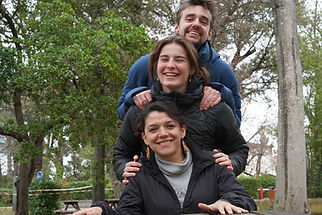
Esteban
Madeleine
Diana
Madeleine Evraert, PROJECT COORDINATOR.
Madeleine discovered complex agroforestry during an internship in Brazil and devoted her gap year to studying it in a temperate climate: first in France with an internship with Diana, then on a European scale with ARISE, in order to explore the practices and share the lessons learned.
Diana Ortiz-Vallejo, SCIENTIFIC REFERENCE.
Diana seeks to contribute to the development of sustainable and resilient food systems by valuing peasant and scientific knowledge to co-produce useful knowledge in contexts rooted in action. To this end, she draws heavily on approaches developed in the Global South, particularly in Brazil and Colombia, her country of origin, where she received her training.
Esteban Chesnel , AUDIO-VISUAL REFERENCE.
Esteban is interested in the anthropological and social dimensions of forests, inspired in particular by Claude Lévi-Strauss's Tristes Tropiques. Passionate about documentary filmmaking, he leads both the SOA expedition in Brazil and Argentina and the ARISE expedition.
Contact us
Phone
+33667249604
Social networks


